Web Development case study
Content Studio
Built for Mindcob. An internal production tool that moves every piece of work from brief through two review gates to design, development and publishing.
The decision that shaped everything else
Model the pipeline as states, not as a column somebody drags
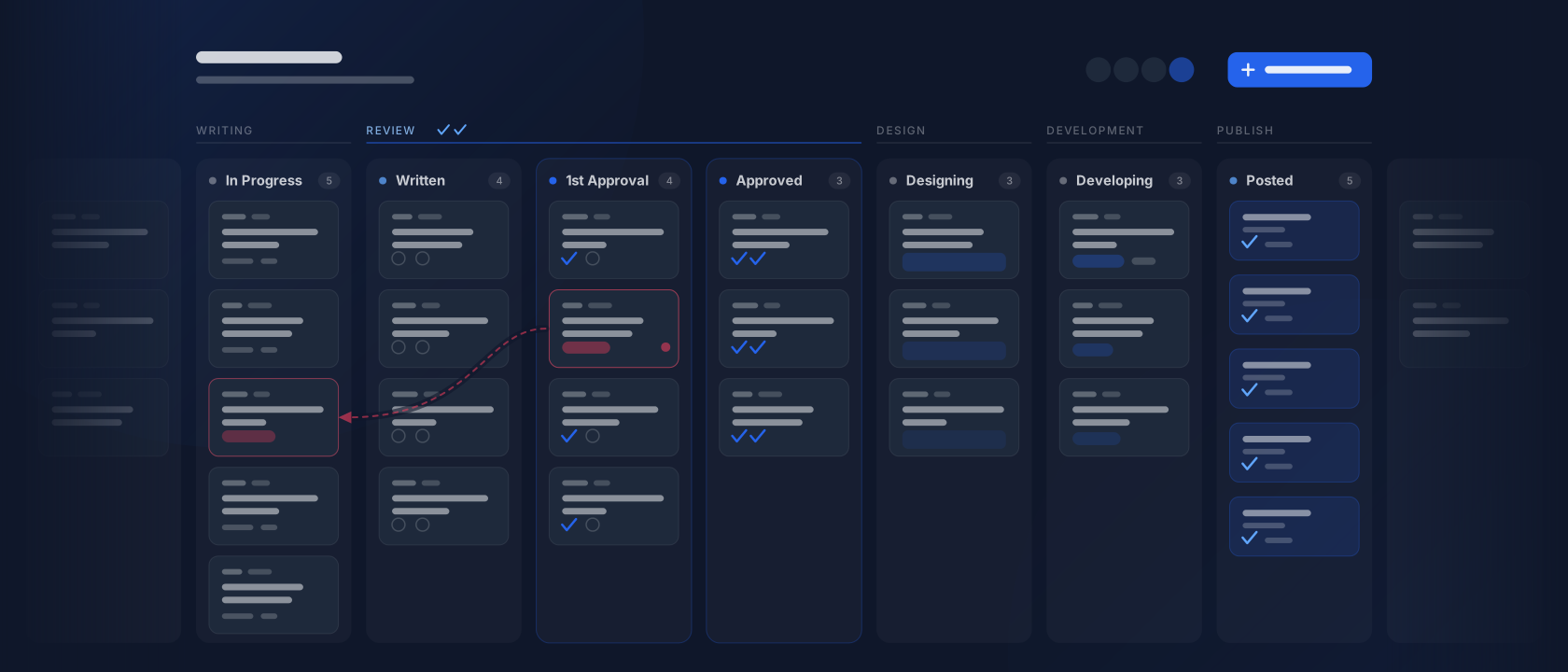
Work moves through an explicit set of statuses: assigned, in progress, sent for improvement, reviewed, ready for design, designing, ready for development, developing, ready to post, posted. Each transition is a permitted move from one state to another rather than a free edit, so a piece cannot arrive at published without having passed the gates in between.
Two reviewers, and the gate needs both
Approval is not one signature. The workflow records each reviewer separately and only releases the piece to design when both have cleared it. Either can send it back with an issue attached, which returns it to the writer with the note bound to the work rather than floating in a chat thread. That single decision is most of what separated this from the spreadsheet.
Every move is recorded, so the audit trail is a side effect
A status history row is written on each transition: what changed, who changed it, when. Nobody has to remember to log anything, because logging is not a separate action. When a piece comes back with problems, the question of who approved it and what they were shown has an answer in the tool.
Four roles, four front doors
Role-based middleware routes each person into their own workspace on sign-in. Admins and managers get the board, assignment and team management. Writers get their queue. Reviewers get what is waiting on them. Designers and developers get what has cleared the gates. Nobody is asked to filter a shared view down to their own work.
The numbers it holds
Content Studio runs Mindcob's production pipeline end to end, from assignment through both review gates to design, development and publishing.
The thing worth taking from it is how little of the value came from the interface. The board is unremarkable. What made it usable was deciding that a status is a state machine rather than a label, that approval needs two named signatures, and that history should be written by the system rather than by the person who remembers to. Those three choices are what a spreadsheet cannot do, and they are the reason the spreadsheet stayed closed.
Internal tools are most of what we build. If your team is running a process through a spreadsheet and a chat thread, that work sits under our Next.js web development service, where the scope, timeline and starting price are published before you talk to anyone.
Tell us what’s slowing you down.
Fixed scope, quoted before kickoff, four to eight weeks to production. You talk to the engineer who writes your code.
Start a project