AI Automation case study
Fiona
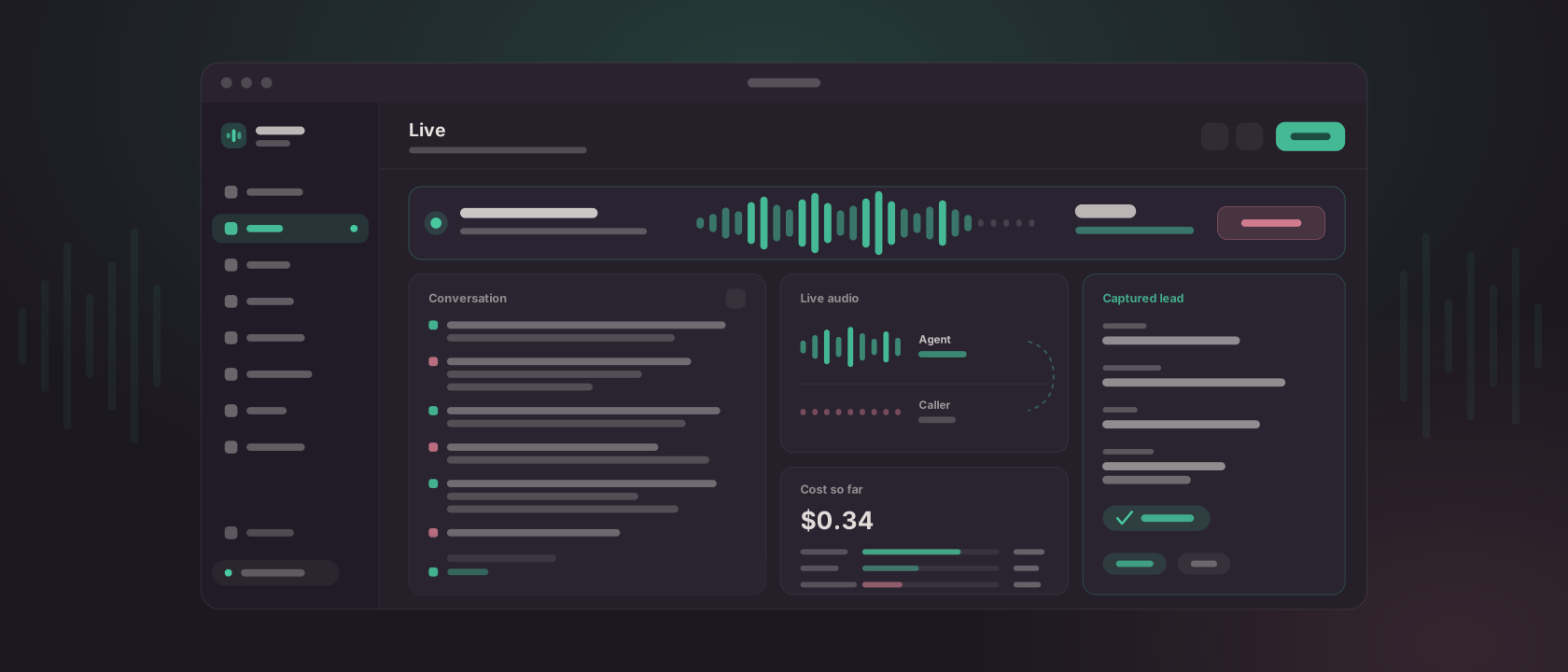
Built for a client. A desktop voice agent that answers and places real phone calls, transcribes them, captures leads, and prices every call from billed usage.
The decision that shaped everything else
A call is a bridge between two sockets
Twilio streams the caller's audio over a websocket. The realtime model expects a websocket of its own. Fiona sits in the middle holding both open, transcoding between telephony G.711 and what the model wants, in each direction, while the conversation is happening. Latency is the whole product here: a delay that would be invisible in a chat interface is a person deciding you are not listening.
Price from what was billed, never from an estimate
Costs come from the exact token counts the realtime API reports and the exact duration Twilio reports, not from a rate multiplied by a guess. Every call carries a real figure, and those roll up per agent and per month broken down by where the money actually went. A team can budget against that.
Capture the lead twice, because the agent will miss things
Agents record structured fields mid-call through tools and confirm them out loud with the caller, which is the only way to be sure a phone number was heard correctly. Then after the call a text model re-reads the entire transcript and catches what the live agent did not. Both paths write into one leads view. Relying on either alone loses records.
Give the campaign the rules a human dialler already follows
Outbound work runs from a spreadsheet: one call at a time, paced rather than blasted, retried on no answer, held inside permitted calling hours in the contact's own time zone, and skipping anyone on the do-not-call list. Those constraints are not features bolted on afterwards, they are what makes the thing legal and tolerable to be on the receiving end of.
The numbers it holds
Fiona handles inbound and outbound calling from one desktop application, with per-call transcripts, summaries, captured leads and costs taken from billed usage rather than estimated.
What we carry out of it is that the hard parts of an AI product are usually not the model. The model was the part that already worked. The work was in the audio path, the billing arithmetic, the calling rules and the second pass that catches what the first missed. That ratio holds on most AI builds we take on, and it is why we scope them around the plumbing rather than the prompt.
Fiona is the deep end of what we build with language models: real-time audio, real money, real phone numbers. That work sits under our AI automation service, where the scope, timeline and starting price are published before you talk to anyone.
Tell us what’s slowing you down.
Fixed scope, quoted before kickoff, four to eight weeks to production. You talk to the engineer who writes your code.
Start a project